Friday, 3 April 2015

Design Query

What kind of LEDs should we use for back lighting?

LEDs are of different types - Diffused, Non-diffused, Water Clear, Tinted Clear. For back lighting use only Non-diffused type. non-diffused type helps light concentrate in a narrow beam and make them appear brighter. diffused LED distributes light over wider beam and is not suitable for back lighting.

Thursday, 12 March 2015

Technology: 3D V-NAND

The days of hard disk drives are gone. Solid-state drives are the trend now. Hard disk drives use that spinning technique and used to be slower. The present day drives with solid state devices (transistors) are the popular ones these days. Lot of innovations have been happening around these solid state drives these days. All these innovations run around power consumption, speed and storage capacity (density). Considering the fact that all our laptops run on batteries and in which SSD are popular, power consumption is a primary factor.

To understand NAND memory in detail, a NAND flash ship consists of memory and associated controller. There are players like TOSHIBA, SAMSUNG, MICRON, HYNIX, SANDISK and others. Basically, NAND flash is used to store OS and other user data. This is the memory source for any system. 

V-NAND:

V stands for vertical where the cells are placed vertically. V-NAND uses charge flash trap technology. This ensures larger aerial densities. This v-NAND uses silicon nitride for charge storage and not polycrystalline silicon. The power consumption of of V-NAND will be 50%  of conventional NAND structures. Also, the read/writes are much faster. This V-NAND uses 10nm technology for construction. The reliability of V-NAND is also high. 

3D V-NAND:

This technology is developed by SAMSUNG which increases storage capacity. this technology basically increases the number of layers with the existing space itself enabling increasing densities. This is a kind of layer stacking. Moving ahead to the higher densities this is very useful. 3D V-NAND is a result of intensive research from SAMSUNG. Take a look at the 850 PRO, 850 EVO from Samsung for latest models.

Saturday, 10 January 2015

Standard Commands for Programmable Instruments (SCPI)

An embedded engineer at some stage of his career has to work on complex test and measurement devices. The devices can be a simple multimeter to a complex oscilloscope. There are various vendors for these devices and many of these devices can be tuned as per the requirements. Tuned here meant adjusting the parameters of the test instrument as per the requirement. For example, take an oscilloscope which has some settings to be done before capturing a waveform. Likewise, any test instrument needs an adjustment for usage in real time application. For all these instruments there will be a human interface at the front end and remote interface at the back end. Using both these interfaces settings can be done. Human interface involves display, touch, keypad where as remote interface involves connecting a remote PC using interfaces like GPIB, RS232, Ethernet, USB.
For communicating with instrument from a remote PC/local and to control it some commands are desired which are defined by Standard commands for programmable instruments (SCPI) . IEEE 488 is a standard which talks about the digital interface connections on the test measurements. IEEE 488.1 talks about physical interface. SCPI is an IEEE 488.2 specification. To make command, syntax, formats common across the interface this standard helps. The standard talks about data format and syntax only and never talks about the type of connectivity that exists in practise.

Few snippets from SCPI:
  1. SCPI commands are organized in a tree structure
  2. SCPI is a software standard to communicate between remote PC and instrument
  3. Any instrument from any vendor will use the same standard fro communication
  4. Communication happens by ASCII text strings
  5. The communication can be powering on an instrument, triggering an instrument as in case of oscilloscope, remote calibration, having a view of the instrument from remote, Querying various parameters, etc.
  6. In depth communication is handled by binary formats
  7. Genuine commands like CONFigure, MEASure are some commands which gives a view into what we can expect from the standard.
  8. SCPI is hardware independent
  9. Tests applications like MATLAB, LAB VIEW also support SCPI. MATLAB supports the programming of instruments using SCPI commands through INSTRUMENT CONTROL BOX.
An example of querying DC voltage from a instrument is as follows:

                                                        MEASure:VOLTage:DC?

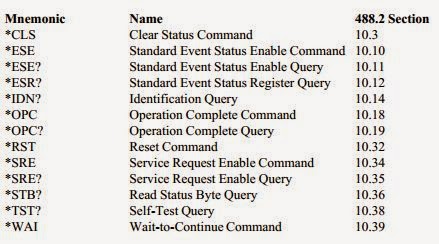
A look of mandatory IEEE 488.2 commands in the below table:

Monday, 29 December 2014

Numato Labs - One stop for FPGA Development boards/Expansion modules

We have been searching for a platform where we could buy reliable FPGA development boards and finally one day we saw a board in www.numatolabs.com. Without second thought we ordered one board which is suitable for us. We received the board today and till now the response from Numato was exceptional.

Advantages of using boards from Numato:

1. Exceptional support
2. Good technical information regarding the board in the site
3. Chance to raise queries using help@numato.com 
4. Quick and flawless delivery
5. Good follow-up


If we share this information in our blog or share via facebook, we are eligible for a lucky draw. More than trying to win a lucky draw it is everyone's duty to share information which is helpful.

Note: We have been trying very hard to find a vendor who can give reliable evaluation boards and we found one. Thanks Numato!!!

Visit: http://www.numato.com/ for more information.

And finally, have a look at this, use this opportunity to enter lucky draw. Good Luck!!!!
http://www.numato.cc/content/mega-new-year-give-away-2015-grab-your-surprise-gift

Friday, 26 December 2014

Circuit Debugging - Tip 1

Let us start learning some of the debugging techniques. Very common component used in electronics is DIODE. Sometimes, by mistake we tend to connect diode in reverse. So, before, mounting a diode the first thing we have to check is the ANODE and CATHODE. The below symbol indicates the polarities and corresponding representation.


If you still have doubt on the polarity, you can check using multimeter. The below figures shows the same:


Saturday, 6 December 2014

Why use Aluminium for mechanicals?

Have you come across mechanical designs for your projects, then definitely you know that aluminium is the most preferred material for such. There are various reasons  for using aluminium and have a glance at the list below:
  • Good thermal conductor
  • Good electrical conductor
  • Can be shaped easily as per requirement
  • Weighs less, density (mass per volume) is less
  • Durable, soft
  • Resist corrosion
  • Non-magnetic
  • Aluminium is the most abundant metal of all.
  • Gets less affected by environment factors like air and water
  • Doesn't effect the environment, can be recycled
  • Less chances of ignition
The conductivity of Aluminium is 50% of copper but still used widely because of cost factor compared to copper.

Very familiar Applications:
  • Have you seen light poles in your area, they are made of aluminium
  • Electrical grid lines
  • Your kitchen cooking utensils
  • Heat sinks for electronic components and mother boards
  • Bus/car/Rail/Aircraft bodies are made of aluminium
  • Railway tracks
  • Cool drink tins
Note: Aluminium may not be used directly in any application and it is compounds (aluminium + other metals) that are used.

Sunday, 2 November 2014

Understanding RS232 interface/signalling - Part 1

Serial port commonly to as RS232 communication is the most widely used interface in embedded systems. Whether it be micro-controller, processor, FPGA the basic interface and the slowest interface that is used is serial port. RS232 communication complies to requirements of EIA/TIA-232 and V.24/V.28 standards. the two main terminologies we come across in these standards are DTE and DCE.

DTE is nothing but an equipment which transmits or receives digital data. This equipment processes the data and converts it into relevant form the users. One of the best examples of DTE is Personal computer (PC). The other examples include printers, fax machines, etc.

DCE is nothing but a simple level converter kind of circuit to make the DTE compatible with communication equipment. Sometimes DCE is a part of DTE and doesn't exist independently. Modems existing in the market are an example of DCE.

The following figure shows the connectivity between DTE and DCE in it's simplest form.


Note: RS232 full form --> Recommended standard-232